
Term Insurance Guide
A simple guide to how term insurance actually works in real life. Let’s go!
Imagine you could buy a product that could replace you. Okay, not you precisely, because that would be a bit silly. But the one thing that your family depends on regularly: your income. Wouldn't you jump on that opportunity? Or maybe pay an annual fee just to hold on to this person? You probably would.
And a term insurance plan does just that. It is your financial replica, and it comes alive when you die.


Let me explain. When you buy a term insurance plan, you pay a small fixed premium every year (or for a chosen payment term) to protect your dependents. And in the event of your passing, the insurance company pays out a large sum of money to your family or your loved ones (nominee). Think ₹1 crore, or ₹5 crore, or even ₹10 crore.
The goal is simple: this money should replace you financially. It should support your family when you're no longer the breadwinner.
A good term plan is also surprisingly clean at claim time, provided the disclosures are made right. If you've been honest about your health, lifestyle, and habits while buying the policy, the insurer pays as per the contract.
With that in mind, let's talk about the two decisions that matter most in term insurance. How much cover should you take? And how long will the policy be kept?
The first question should be obvious by now: How much money does your family need to replace you financially? It's a tough question, and let's be honest, it is a bit subjective as well.
For most families, the payout needs to do three jobs. First, replace the day-to-day income so the household can keep running. Second, clear big liabilities like a home loan so EMIs don't become a burden. And third, fund major goals that won't wait, like children's education. At Ditto, we've built a cover calculator to help you understand your ideal cover.
But remember a few key things: your expenses, any uninsured outstanding loans, and long-term goals like children's education. If your lifestyle demands a certain level of spending, you will need to keep it up if you don't want your absence to be felt, and your term insurance should replace this income, taking inflation into account.
If your family needs ₹50,000 a month today to run the household, that number won't remain the same forever. Even at 5% inflation, expenses could roughly triple over 20 to 25 years. So when you choose a cover, you don't pick a number that works only for today, but that can hold up over time.
Now imagine your family receives that payout and does something conservative with it, like parking it in an FD (fixed deposit) and using the returns to fund expenses. That payout should be large enough to generate meaningful cash flows for long enough, while still leaving a buffer.
With a term insurance plan, you keep paying premiums as long as the policy remains active or until the payment tenure ends, whichever comes first. So there is an expiration date of sorts, and it's on you to decide how long you want to keep your policy. And you have to make this choice at the time of purchase. You can't tweak it later without buying a new policy, so a lot is riding on this.
Once again, you are looking to replace yourself financially. When you're young, your family won't have a lot of savings to fall back on. As you grow older, however, that changes. By 60, your kids may be financially independent, your spouse may have a retirement fund to lean on, and you may not have many people relying on your income. So 60 is a good place to start. And in most cases, it's best to keep the cover somewhere between 60 and 70. Once you push the coverage beyond that, premiums tend to jump sharply, and you often end up paying a lot for relatively little extra benefit.
Now that you know how to decide the cover amount and the policy duration, let's get into the mechanics of how a term plan actually works in real life.
Here's a simple breakdown of how a term plan works from start to finish.
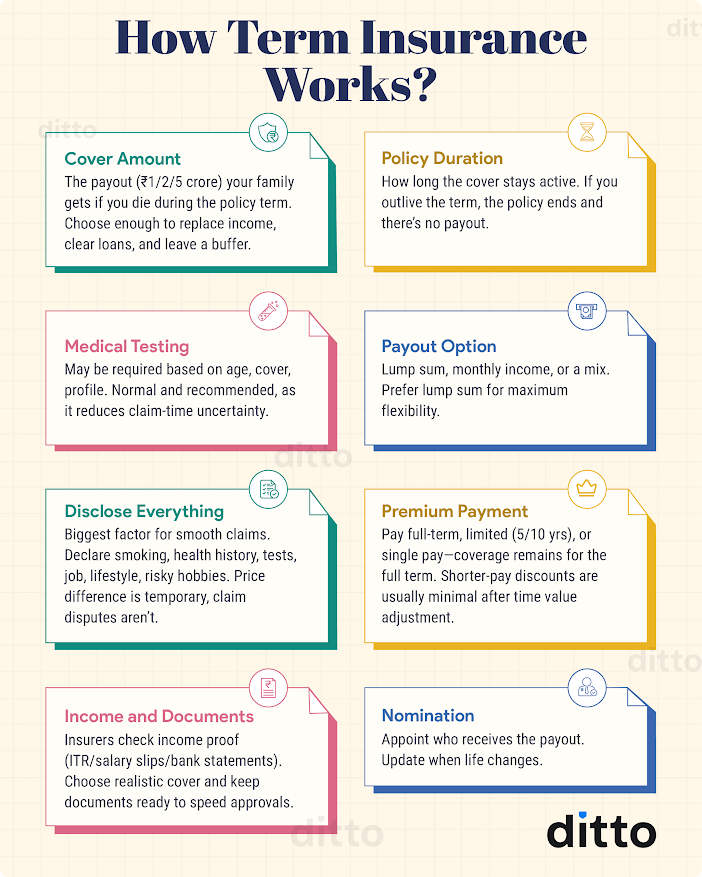
Now that we have a basic understanding of how things work, let's look at which type of plan would make the most sense for you.
Pure Term (Plain Vanilla)
This is what most people should buy. It is the cheapest way to get a large cover, and it does exactly what term insurance is supposed to do: protect your family if you die.
Zero Cost or Special Exit
This is basically a pure term plan with an option to exit at a pre-defined time and get back base premiums (excluding riders, GST, and underwriting charges). It can make sense if you expect your liabilities to reduce mid-way and want the option to walk away with a refund, but it only works if you exit exactly as per the plan rules.
ROP (Return of Premium)
You get life cover, and if you survive the term, you get your base premiums back (excluding riders, GST, and underwriting charges). The catch is you pay a lot more for that comfort, and the refund is just premiums paid, not a meaningful "return". For most buyers, we do not recommend it because the cost-to-benefit ratio is poor.
Increasing Cover (Inflation-linked cover)
Your cover increases by a fixed percentage each year (usually 5% or 10%), so you do not have to "overthink" inflation upfront. But premiums for these plans are usually much higher than a straightforward term plan, so you are paying extra for convenience, often materially. Also, remember, the cover increases, not your income, so it is usually better to pick a sensible, sufficient cover upfront rather than relying on future step-ups.
Decreasing Cover (Cover reduces with time)
Here, the sum assured decreases gradually over the policy term. It can work when your insurance needs are clearly tied to a debt, but it is risky for family protection because real-life expenses do not neatly go down on schedule.
Bottom line: Most people are best served by a clean, pure term plan and investing the extra money they would have paid for ROP or fancy variants in better avenues like PPF, NPS, or mutual funds.
You don't need a fancy plan variant. But you might need the right rider. Here are the ones that are actually useful.
Buying term insurance shouldn't feel like a blind bet. So if you've ever wondered how much cover you actually need, which riders are worth it, or how long your policy should last, we've got just the thing.
Join our FREE 90-minute masterclass where our IRDAI-certified experts break down all the stuff that actually matters in simple, jargon-free terms. 10,000+ people have already walked away with clarity. Register now to reserve your spot.
A serious illness can drain savings and pause your income at the same time. Health insurance pays hospital bills, but it does not replace lost earnings.
This is where a critical illness benefit helps: if you're diagnosed with a listed illness, the insurer pays a lump sum (₹10 lakh, ₹25 lakh, ₹50 lakh, etc.) that you can use to replace lost income and cover non-medical costs. A good starting point is 1 to 2 years of your income.
Always check waiting periods, survival periods, illnesses covered, and whether the payout reduces your base term cover or not.
When a doctor says you've got limited time, you don't start counting days. You look for treatment, second opinions, maybe even options abroad. The problem is that it costs money.
A terminal illness benefit pays out your entire cover once the illness is certified, giving you the money in advance for treatment or anything else. Even if you live longer than expected, the insurer does not take it back.
But certification and claim acceptance can be difficult in practice. Most policies include this benefit inbuilt, so the question is not opting in, but whether it will work smoothly when needed. Also, remember, once paid, the final death benefit reduces by the same amount.
Term plans are rigid. ₹1 crore bought years ago stays ₹1 crore, even after marriage, children, or a home loan.
Life stage benefits let you increase cover by 25% or 50% at specific milestones. If you are unmarried today, this flexibility can help.
But premiums for the added cover are based on your age, then, health checks may apply, and increases are allowed only for defined events within fixed time windows. Often, buying sufficient cover upfront or comparing with a fresh plan later is smarter.
India sees roughly 55 road accidents and 20 deaths every hour. If that worries you, an accidental death benefit rider may help.
You pay extra, and your family gets additional money on top of the base term cover if death is due to an accident. But never reduce your base cover for this. Your base policy already pays for accidental death. This rider only adds more.
It may suit people with risky jobs or frequent road travel.
Surviving an accident with a permanent disability can stop your income while expenses continue.
This is where an accidental total and permanent disability rider can help. It pays a lump sum, a monthly income, or both if an accident leads to a listed total and permanent disability. You can use it to replace lost earnings or adjust your lifestyle.
Definitions are tightly worded, documentation is strict, and some riders cover only specific outcomes. It is most relevant if losing earning ability worries you more than death.
Keep it simple. Add a Waiver of Premium rider, consider Critical Illness if income risk worries you, and skip the rest unless you have a specific reason.
1) Instant Payout on Claim Intimation
Some new term plans offer an "instant payout" feature where a small part of the death benefit, usually ₹1-5 lakh, is released within 24 hours of the claim registration and document submission. This way, the family has cash for urgent needs while the full claim is processed. This amount is an advance and gets adjusted against the final payout, plus it can come with conditions. In case the claim gets rejected, the family will have to pay back this amount to the insurer.
2) Premium Break or Cover Continuation Benefit
If you hit a rough patch like job loss or an income gap, some plans let you pause premiums for a short period (usually up to a year) without the policy lapsing. The cover continues, but any claim during the break may be paid after deducting the unpaid premiums, and eligibility rules apply. But remember, you still have to pay those deferred premiums the next year, along with that year's regular premium.
3) Health Management Services
Some term plans bundle add-on services like teleconsults, second opinions, wellness coaching, mental health support, or care coordination. These are complementary, often delivered through third-party partners, and they do not pay hospital bills or replace health insurance.
All of this sounds good on paper. But term insurance is truly tested only at one point: claim time. Let's understand how claims work.
One day, the worst happens. The last thing your family should ask is, "Did we even have a term policy?"
Fix this now. Tell your nominee the insurer's name, policy number, and where the documents are stored. Make sure nominee details match their KYC. If the nominee is a minor, appoint a guardian.
At claim time, the nominee informs the insurer and submits the claim form, death certificate, KYC, and bank details. If the death is accidental or suspicious, insurers may ask for an FIR or post-mortem report. The process is simple, but document-heavy.
If you bought through Ditto, your family should call our claims team. We help with filing, documentation, follow-ups, and escalation if needed.
Now the critical part. Claims depend on what you disclosed when buying the policy. Declare everything, even "minor" issues like past illnesses, symptoms, medication, tests, and hospitalizations. Keep basics consistent too: name, DOB, address, and nominee details must match your application.
Note: Death benefit is tax-free under Section 10(10D).
IRDAI Timelines
- No investigation: settle within 15 days
- Investigation required: settle within 45 days
Buying the policy is step one. Making sure the claim goes through smoothly is what truly matters.
Choosing the right cover amount, policy term, and add-ons can get overwhelming. Speak to a Ditto advisor. We'll help you figure out how much life cover you actually need, compare the right term plans for your situation, and walk you through the fine print before you buy.
or with a Ditto advisor.