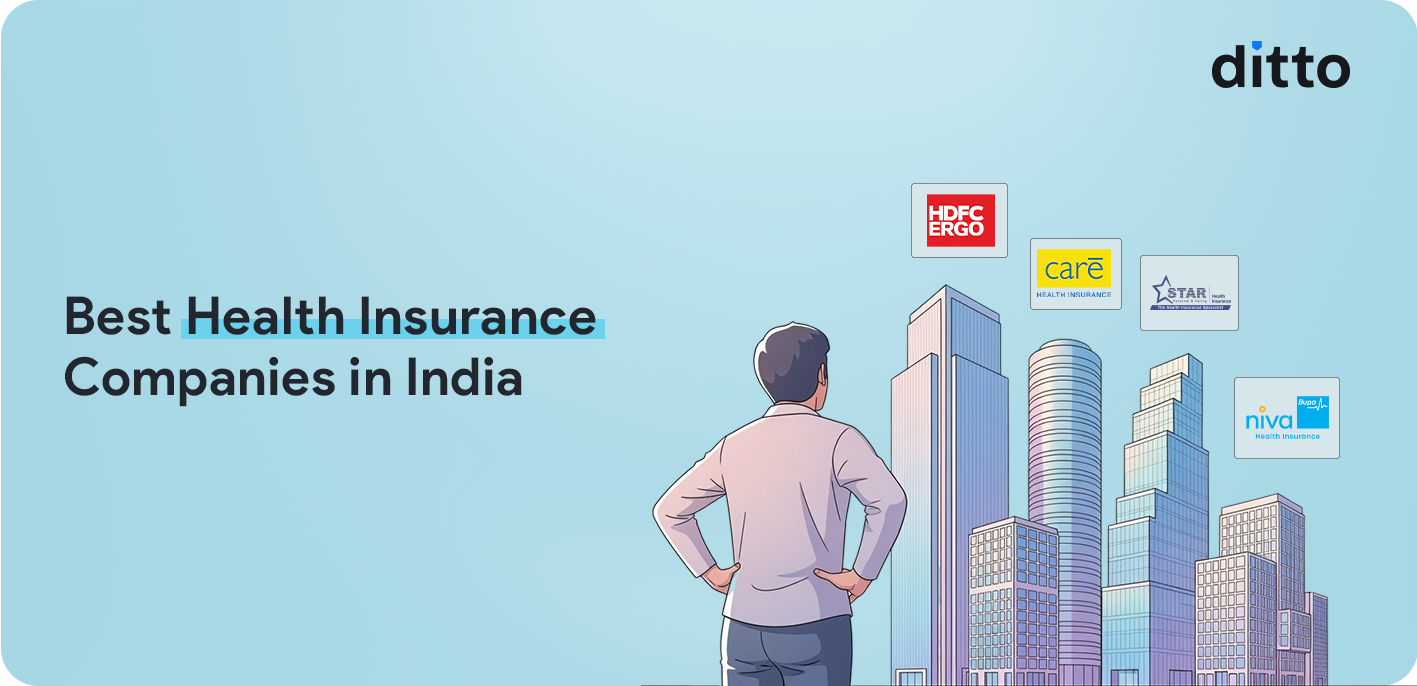
When it comes to health insurance, there isn’t a single company that can be called “best” for everyone and not all insurers are among the top 10 health insurance companies by CSR in India. It could be reliable claims support, strong hospital coverage, or long-term stability.
That’s why, instead of blanket rankings, we use a published insurer rating methodology. Each company is first scored on six measurable parameters — Claim Settlement Ratio (CSR), Complaints, Gross Written Premium (GWP), Hospital Network, TPA model, and Online Services, which are combined into a 10-point insurer rating.
For simplicity, we present this rating on a 5-point scale called the Ditto insurer score. This makes the comparison easy to read, while the underlying calculation remains transparent and data-driven exactly as required by IRDAI’s directives. You can read the full methodology here.
Using this framework, here are the top 10 Health Insurance Companies in India for 2026, ranked based on the Ditto insurer score (5-point scale):
Still confused about which health insurance aligns with your needs? Ditto’s IRDAI-certified advisors can assess your healthcare requirements and help you pick the right policy. And the best part? We don’t spam or pressure you to buy. So book a call now.
How to Choose the Best Health Insurance Companies in India?
Picking the right insurer isn’t about flashy ads or the cheapest premium. A good company should be financially sound, settle claims fairly, and make the process simple. That’s why we developed an insurer rating methodology, i.e., a transparent, data-driven approach to evaluating every insurer.
Each insurer is scored on these six measurable parameters, combined into a 10-point rating with this formula:
Insurer Rating = (0.22 x CSR Rating) + (0.17 x Network Hospitals Rating) + (0.15 x Complaints Volume Rating) + (0.25 x GWP Rating) + (0.1 x TPA Rating) + (0.1 x Online Presence Rating)
The 6 Factors Behind Our Rating
01
Claim Settlement Ratio (22%)
The Claim Settlement Ratio (CSR) measures the percentage of claims an insurer pays out versus the total claims received. At Ditto, we look at a 3-year average to even out any extraordinary events in any one year. A higher CSR indicates reliability in paying valid claims on time.
02
Complaints Volume (15%)
Complaints volume shows how many customer grievances an insurer receives, normalized per 10,000 claim volumes. The fewer the complaints, the better the claims process, generally.
03
Gross Written Premiums (25%)
Gross Written Premium (GWP) is the total premium an insurer collects in a year, reflecting its market scale and growth. At Ditto, we see this as a proxy for financial stability and operational maturity. A larger insurer is generally better equipped to handle high claim volumes.
04
Hospital Network (17%)
The hospital network represents the total number of hospitals where an insurer offers cashless claim facilities. At Ditto, we value insurers with broad networks (usually 10,000+ hospitals) since they make cashless access easier and reduce out-of-pocket expenses for policyholders.
05
TPA Model (10%)
The TPA model outlines the process for processing claims either in-house or through third-party administrators (TPAs). At Ditto, we generally favor in-house models, as they tend to be faster, more accountable, and aligned with the insurer’s service standards.
06
Online Services (10%)
This is nothing but the Digital convenience for policy purchase, renewal, and claim tracking enhances user experience and transparency.
Together, these six signals give you a clear view of who pays reliably, who keeps customers happy, and who offers strong hospital access. Then, we standardize the score into the Ditto insurer score (5-point scale), so you can compare companies at a glance while knowing the math underneath is transparent.
Overview of the Best Health Insurance Companies in India
Now that we’ve explained how the insurer score is calculated, let’s look at how the top insurers actually perform on these parameters. We’ll go one by one, breaking down what each company does well, where they fall short, and what that means for you as a customer.
This way, you’re not just seeing a rank or score, but also getting context on why an insurer deserves its spot and what to watch out for before choosing a plan.
01
HDFC Ergo
HDFC ERGO stands out as one of the most dependable health insurers in India. It has built trust on the back of consistently high claim settlement performance, a huge hospital network, and strong financial backing. Customers also benefit from in-house claim servicing and a smooth digital experience — two things that make a real difference when you actually need to use the policy.
The catch? HDFC ERGO’s plans usually come at a premium. You’re paying extra for reliability and convenience, so it’s worth checking whether the higher cost makes sense for your needs when similar alternatives exist.
3x Secure Benefit from Day 1; Grows up to 5x with bonus and restoration; Inbuilt consumables coverage; Rider for OPD coverage, PED waiting period reduction, hospital cash, unlimited restoration & unlimited coverage (once or twice during policy lifetime) and maternity
Day 1 Coverage for Diabetes/Hypertension; Wellness tests covered; Premium discounts up to 25% for maintaining a healthy lifestyle
Sum Insured: ₹5L to ₹50L
02
Bajaj General
Bajaj General doesn’t always get the same spotlight as HDFC ERGO, but its service record is arguably even cleaner. With one of the lowest complaint ratios in the industry and consistently strong claims performance, it’s a solid choice if hassle-free claims are your top priority.
Bajaj
General
4.99
Overall Rating
CSR Rating
5.0/5
Network Hospital Score
5.0/5
GWP Score
5.0/5
Customer Service Rating
5.0/5
Takeaway:
Bajaj General is the insurer you go to if you want smooth servicing and minimal escalation risk. But here’s the catch: as an advisor, we don’t just evaluate insurers, we evaluate products.
Bajaj General’s product portfolio doesn’t really stand out. The plans are decent but not especially competitive on features or value, which makes it harder for us to recommend them with confidence. But these concerns are slowly being addressed. Some of their newer offerings show signs of improvement, such as more thoughtful features, clearer terms, and better alignment with customer needs.
Even a strong insurer can fall short if its products don’t offer the right features, because at the end of the day, what you actually buy is the policy, not just the company. That’s why Bajaj General, despite its excellent servicing record, isn’t part of Ditto’s partner list yet.
Bajaj General Overview
Metric
Bajaj General
Context
Claim Settlement Ratio
96.77%
Strong & stable
Complaints (per 10k claims)
3
Among the lowest in the industry
Hospital Network
12,000+
Wide cashless access
Gross Written Premium
₹6,119 cr
Fairly large, in line with HDFC ERGO, Care Health, and Niva Bupa
03
Aditya Birla Health
Aditya Birla Health is one of the newer standalone players but has scaled quickly since its launch in 2016. On paper, it appears solid: a 96% claim settlement ratio, a robust 12,000+ hospital network, and a growing premium book of approximately ₹3,290 crores. The company has also built a reputation for linking insurance with wellness by offering rewards for fitness, digital health tools, and preventive-care nudges are part of its brand.
The downside? Customer experience has room for improvement. With a slightly higher complaint volume than some peers, there’s a bit of a gap between the innovation and day-to-day servicing consistency. But as the company matures, these are areas that could stabilize further.
Aditya Birla
Health
4.49
Overall Rating
CSR Rating
5.0/5
Network Hospital Score
5.0/5
GWP Score
3.0/5
Customer Service Rating
5.0/5
Takeaway:
Aditya Birla Health brings energy and innovation to the table, but the service side hasn’t caught up fully yet. It’s attractive if you want wellness-linked features, but if your #1 priority is to have better claim servicing or a larger insurer, you’ll find steadier options elsewhere.
Unlimited RestorationInbuilt loyalty bonus of 100% p.a upto 500%, regardless of claimsUpto 100% renewal premium discount based on active lifestyleInbuilt consumables coverage
Same base features as Fit plusAdditional coverage for maternity and newborn child expenses after a 3-year waiting period.Covered up to 2 Deliveries/terminationsNormal Delivery - Rs. 40,000 C-Section Delivery – Rs. 60,000
₹5L – ₹1 Cr
Talk to an expert today and find the right insurance for you.
Unlimited Restoration; Inbuilt loyalty bonus of 100% p.a upto 500%, regardless of claims; Upto 100% renewal premium discount based on active lifestyle; Inbuilt consumables coverage
Same base features as Fit plus; Additional coverage for maternity and newborn child expenses after a 3-year waiting period. Covered up to 2 Deliveries/terminations; Normal Delivery - Rs. 40,000 C-Section Delivery – Rs. 60,000
₹5L – ₹1 Cr
04
Care Health
Care Health is one of the largest standalone health insurers. Its big draw is access: a very wide cashless network and strong digital plumbing, which makes it easier to find a tie-up hospital and get paperwork moving. Scale helps too. The book is sizable so day-to-day ops feel well-oiled. The trade-off is service variability: complaint rates are higher than top peers, and the claim settlement ratio slight trails the leaders though above industry averages, so experiences aren’t as consistently smooth
Care
Health
4.23
Overall Rating
CSR Rating
4.5/5
Network Hospital Score
3.0/5
GWP Score
5.0/5
Customer Service Rating
3.0/5
Who is this for?
Buyers who prioritise cashless access across metros and tier-2/3 cities.
Families that want wide network coverage for travel or multi-city living.
Watch-outs
Higher complaint volume than peers → manage expectations on servicing.
Care Health Overview
Metric
Care Health
Context
Claim Settlement Ratio
93.13%
Slightly lower than the top group
Complaints (per 10k complaints)
42
Higher escalation rate vs peers
Hospital Network
11,400+
Among the largest cashless networks
Gross Written Premium
₹6,775 Cr
Large standalone scale
Who is this for?
Buyers who prioritise cashless access across metros and tier-2/3 cities.
Families that want wide network coverage for travel or multi-city living.
Watch-outs
Higher complaint volume than peers → manage expectations on servicing.
Note: Care is a partner insurer at Ditto, and our experience with their claims support has been reasonably smooth so far. While we remain cautious about the servicing data, our team has not faced major red flags in the actual claim process.
Affordable extra coverage over the base plan; No copay, no disease-wise limits and Any Room option (with add-on); Unlimited restoration and a no-claim bonus of 10% p.a upto 100%
Plan of last resort for severe PEDs; Basic coverage, but with copay, disease-wise limits, and room rent restrictions; PED WP of 2 years only; Riders for Health check-ups, OPD, and Home care
₹3L – ₹10L
05
Niva Bupa
Niva Bupa may not have the big-brand heft of HDFC ERGO or ICICI Lombard, but makes up for it with product innovation. Whether it’s ReAssure 2.0, 3.0, or Aspire, Niva consistently experiments with benefits, pricing, and flexibility, often leading the market in fresh product design.
Niva
Bupa
4.23
Overall Rating
CSR Rating
4.5/5
Network Hospital Score
3.0/5
GWP Score
5.0/5
Customer Service Rating
3.0/5
Takeaway:
Niva Bupa is a product innovator first, insurer second. Its catalogue is filled with thoughtful ideas, from unlimited reinstatements to lock-the-clock and they come at very competitive prices. But scale and complaint volume remain some of its weak spots, keeping it just below the top players, while still retaining a spot in the top 5.
In short, if you’re looking for feature-rich, value-for-money health plans, Niva Bupa often sets the benchmark. Just ensure you have the right advisory support, because with great product variety comes the need for careful plan selection.
Niva Bupa Overview
Metric
Niva Bupa
Context
Claim Settlement Ratio
92%
Strong, though not quite in the top bracket
Complaints (per 10k)
43
Higher than desirable; servicing consistency needs work
Hospital Network
10,000+
Strong and expanding
Gross Written Premium
₹5,481 Cr
Mid-sized; growing rapidly but still smaller than top general insurers
Also, while the top five insurers deserved a closer look, the rest of the top 10 also score well on our insurer rating and are worth knowing about. Here’s a quick snapshot of what they do well, where they fall short, and the type of customer they might suit.
06
SBI General
SBI General feels like a safe, balanced option. A 96% claim settlement ratio and 16,600+ hospitals mean it’s strong on the basics. Complaints are middling (21 per 10k Claims) — not bad, but not the best either. If you want a familiar brand with wide access, SBI ticks those boxes.
SBI
General
3.79
Overall Rating
CSR Rating
5.0/5
Network Hospital Score
3.0/5
GWP Score
3.0/5
Customer Service Rating
3.0/5
07
Go Digit
A new-age, digital-first insurer. Digit has a 99% claim settlement ratio and a wide network of 16,400+ hospitals, though its premium book is still relatively small (₹1,388 Cr). Complaints are at 17 per 10k claims, which is reasonable.
Moving forward, we would like the insurer to have a similar CSR and claims performance as they scale up. However, currently, Go Digit is best suited for buyers who are comfortable with app-first servicing and want a modern interface.
Go
Digit
3.7
Overall Rating
CSR Rating
5.0/5
Network Hospital Score
5.0/5
GWP Score
2.0/5
Customer Service Rating
4.0/5
Future Generali - 3.64/5
Future Generali posts impressive metrics on paper. They have a 92% claim settlement ratio and just 11 complaints per 10k claims. But despite the strong numbers, its smaller operating scale keeps it out of the top bracket. A solid, improving insurer, but not yet in the league of the big guns.
09
ICICI Lombard
ICICI Lombard has long been a heavyweight in general insurance. They have a large network, strong digital systems, and trusted branding. But much of the recent buzz comes from Elevate, its flagship health plan that’s been seeing growing interest for its flexibility and modern add-ons. Still, when you strip away the product appeal and focus purely on insurer metrics, the 85% claim settlement ratio remains a concern. In other words, an excellent insurer whose CSR number lets them down a bit.
ICICI
Lombard
3.65
Overall Rating
CSR Rating
1.3/5
Network Hospital Score
3.0/5
GWP Score
5.0/5
Customer Service Rating
4.0/5
10
Tata AIG
Tata AIG is one of the oldest private sector insurers in the country. It has a claim settlement ratio of 89%, which is on the lower end of its peers. It also falls short when it comes to its product line-up. When we run plan features through our framework, Tata AIG’s policies don’t break into the top tier, so there isn’t a clear, standout recommendation from us yet. That said, newer offerings like Medicare Select are a step in the right direction.
Tata
AIG
3.43
Overall Rating
CSR Rating
2.5/5
Network Hospital Score
3.0/5
GWP Score
3.0/5
Customer Service Rating
4.0/5
Why Talk to Ditto for Your Health Insurance?
At Ditto, we’ve assisted over 8,00,000 customers with choosing the right insurance policy. Why customers like Srinivas below love us:
No-Spam & No Salesmen
Rated 4.9/5 on Google Reviews by 15,000+ happy customers
Backed by Zerodha
100% Free Consultation
You can book a FREE consultation. Slots are filling up quickly, so be sure to book a call now!
Conclusion
There isn’t a single “best” health insurance company for everyone. Each insurer has its strengths - some excel at claim servicing, others at network coverage, and a few at product design. The right choice depends on your priorities: smoother claims, wider access, or richer features.
At Ditto, our rankings are built on a transparent, data-driven framework that uses IRDAI-mandated public disclosures, including claim settlement ratios, complaint volumes, hospital networks, gross written premiums, TPA models, and digital presence. These are combined into the Ditto insurer score (5-point scale), making it easier to compare insurers while keeping the methodology objective and consistent.
We also believe in full transparency around our partnerships. Our current insurer partners are ICICI Lombard, Star Health, Care Health, Niva Bupa, Aditya Birla Health, and HDFC ERGO. But as you can see in this list, the rankings include both partners and non-partners because the methodology is unbiased and applied uniformly across all insurers.
For a detailed explanation of our process, partnership policy, and disclaimers, please see our Editorial Policy & Disclaimers document.
To understand why public sector insurers were not included in our list, watch this video.
Finally, this analysis is based on publicly available information and should not be treated as personalized advice. Always read the policy documents carefully and consult a licensed advisor before purchase.
Frequently Asked Questions
Which are the top 10 health insurance companies in India?
The top health insurance companies based on CSR, complaint volumes, hospital networks, and online services include HDFC ERGO, Bajaj General, Aditya Birla Health, Care Health, Niva Bupa, SBI General, Go Digit, Future Generail, ICICI Lombard, and Tata AIG.
Can I switch my health insurance policy from one company to another in India?
Yes. In India you can move, or “port”, a health insurance policy from one insurer to another at the time of renewal without losing continuity benefits such as credit for completed waiting and moratorium periods. However, there are rules, timelines, underwriting checks, and some limitations you must understand before you apply.
What are the different types of health insurance policies offered by insurance companies in India?
Insurers in India sell a wide range of health products to suit different life stages, budgets, and needs. The major categories are: Individual, Family floater, Senior-citizen specific, Group, Critical-illness, Maternity, Top-up / Super-top-up, Hospital-cash/Daily cash, OPD cover, Personal-accident, Disease-specific (e.g., cancer,) and several niche covers (surrogacy, persons with disability, or dengue). IRDAI has also standardized many product features in recent years, so overlaps and common minimum coverages are increasing across insurers.
Which health insurance provider has the best claim settlement ratio?
The health insurance provider with the best claim settlement ratio in 2024-2025 considering three year avg. data is New India Health, followed by Digit, Bajaj General, HDFC ERGO, and Acko. Out of these, only New India, HDFC ERGO, and Bajaj General operate at a scale that makes their CSR truly noteworthy.
How many Health Insurance Companies are there in India?
As of 16 September 2025, 33 IRDAI-registered non-life (general) insurers underwrite retail health/mediclaim products in India, and 6 of those are registered standalone health insurers. In addition, 26 life insurers exist (they primarily sell life cover but may offer limited health riders). If you count every company a consumer can approach for health-type cover (non-life insurers + standalone health insurers + life insurers offering riders), the practical universe is 33 non-life + 26 life = 59 companies (but only the 33 non-life/standalone firms underwrite full hospitalization products).
Why People Trust Ditto
4.9
19343 reviews
Had a great experience purchasing my term plan through Ditto. The support team was very helpful and transparent. They explained every detail clearly and ensured I chose the right policy. No pushy sales, just honest advice. Highly recommended!
CKRK
Chaitanya Kumar Reddy Kethireddy
Great experience with Ditto for my term insurance. The entire process was smooth and well handled end-to-end. Special thanks to Sai Keerthi and Anup for their clear guidance, patience, and support. Highly recommend!
ST
SaiKrishna Thaniparthi
Absolutely loved the services and guidance provided by Sruthi and Ditto Team for Term insurance. She helped me with all my queries and made sure that I get complete satisfaction before I make any purchase. Thanks Ditto
HG
Himanshi Gupta
I had a great experience with Ditto Insurance. Their team explained my team policy questions very clearly and patiently. They didn’t push any product, just guided me properly. Really appreciate their support and transparency.”
MM
Manoj Mondal
Thanks to Ditto for making the entire process so easy and convenient from objectively understanding different policies to choosing the right one and finally buying it. The Ditto team was always available and guided me through every step. Shoutout to Ditto!